

More people aren’t getting the help they need for basic services, which has meant the library is asked to fill that gap.

By Anna Berg and Sam Jefferson, for the Community News Service
The Rutland Free Library is in an old brick building on the edge of downtown. Behind heavy wooden doors, comfy chairs and tables wrap around tall bookshelves.
Amy Williams, assistant director, has been working at Rutland Free for eight years and knows all the ins and outs of the library. At the entrance, she points out resources that visitors can take for free, like hats and gloves.
“We have a warm things tree, and sometimes some hygiene kits. Those always go super fast,” Williams said.
The library also offers drug testing kits to grab on the way out.
“Essentially, it’s test trips so you can test your street drugs for fentanyl,” she said. “We had four and they were gone in under three hours — maybe in an hour; I just didn’t think to look that quickly.”
In the middle of the main floor, there is the librarian help desk. Staff consider this the mission control center of the library, built to handle the everyday library stuff, like checking books out. But the staff are also mindful of something else: security. Because of past issues with disruptive situations, they like to keep an eye on who’s in the library, where they are, and what they’re doing.
“So every time we switch over, before you sit down at the help desk, you’re supposed to do a walk up here and just see who’s here,” Williams said.
The bathroom is another place in the library that the staff pay extra attention to. It’s near the entrance of the building and open to anyone, but staff keep the keys at the help desk.
Despite these precautions, this past November, a patron almost overdosed.
“He came in to use the restroom, and after several minutes he hadn’t come out of the restroom and someone said, ‘Hey, that person’s in the restroom and not responding,’” said Randal Smathers, the director of Rutland Free. “I knocked and used my master key and went in, and he was laying under the sink and his syringe was in the sink.”
“I knocked and used my master key and went in, and he was laying under the sink and his syringe was in the sink.”
Randal Smathers, director of the Rutland Free Library
Smathers was able to revive the person, and they ended up being OK, but this wasn’t a one-time occurrence. It was the latest in a string of incidents that stretch the definition of the typical services a library might provide. And Rutland Free isn’t alone. It was one of the concerns documented in a recent report to the Vermont Legislature on the status of libraries across the state.
Catherine Delneo, the Vermont state librarian and commissioner of libraries, said libraries have always been a point of contact to help connect people to social services.
“Someone who needed help accessing a government service or a social service may have gone to the library to do that in the 1950s, the 1980s, and they’re still doing it today,” Delneo said.
But what is changing is that more people aren’t getting the help they need for basic services, which has meant the library is asked to fill that gap.
“Because we’re still open to everyone in public libraries, we’re still welcoming everyone,” Delneo said. “But sometimes people’s behaviors in the library could be a little bit challenging for staff to manage.”
Many librarians across the state, including Jennifer Murray, the director at the South Burlington Public Library, echo this sentiment.
“People who have been working in libraries for a long time in particular find themselves saying, ‘Wait a second, this isn’t what I signed up for,’” Murray said.
In Barre, at the Aldrich Public Library, assistant director Garrett Grant said one way his library addresses some of those rising needs is by providing snacks during after school programming.
“I would get kids that would come here just to get snacks,” Grant said. “At my teen night programs, we go through a lot of food, we feed [the kids] a meal.”
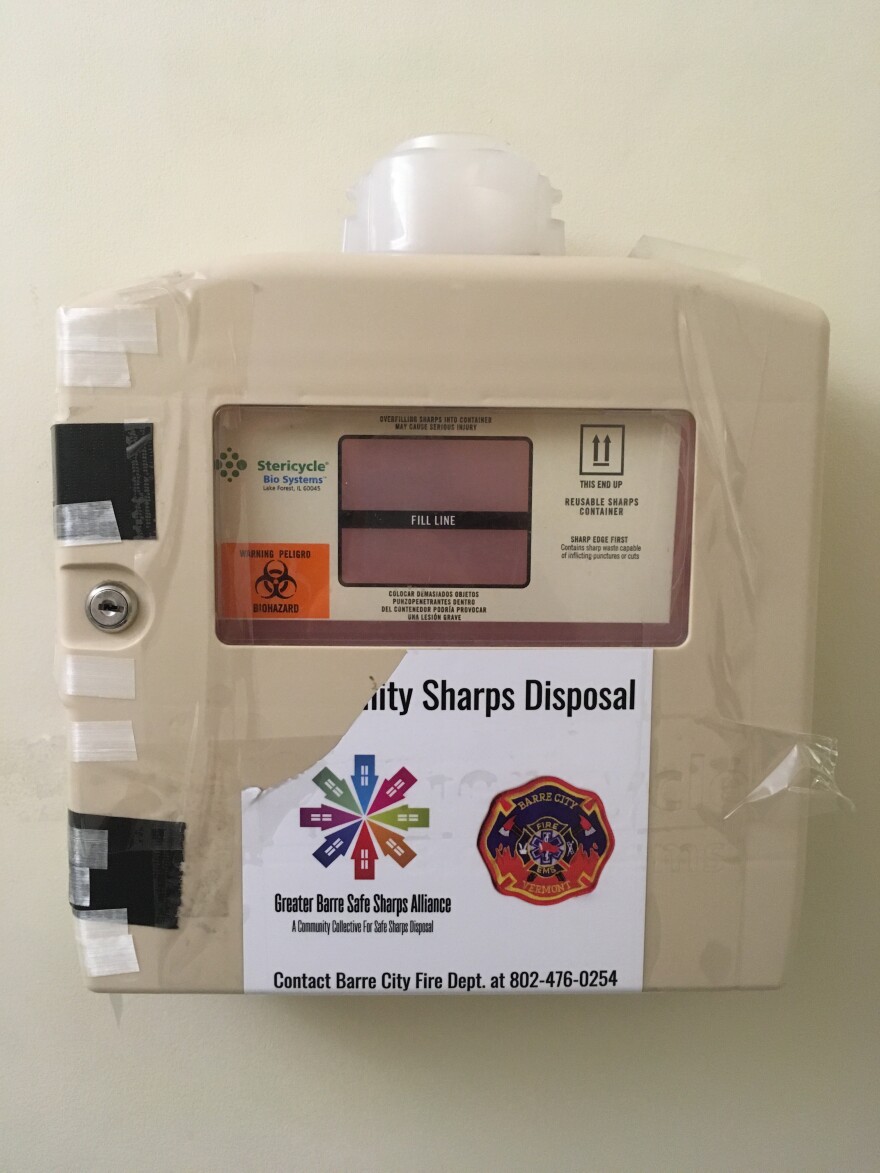
Aldrich also offers a place to put used needles. The sharps container is located in their bathroom on the ground floor and is being held together with book tape. Grant said it’s old, but that’s not the only issue: Right now, the container is at capacity and whose job it is to empty it is up in the air. The local fire department used to have grant funding to empty them, but then it ran out. Without space in the containers, librarians find needles on the ground.
“When it was at its fullest, and you couldn’t add anything else, that’s when you do start to see them around the library,” Grant said.
At the Aldrich, the librarians have to dispose of the needles themselves. Grant says a volunteer showed them how to use an empty plastic water bottle to pick them up safely.
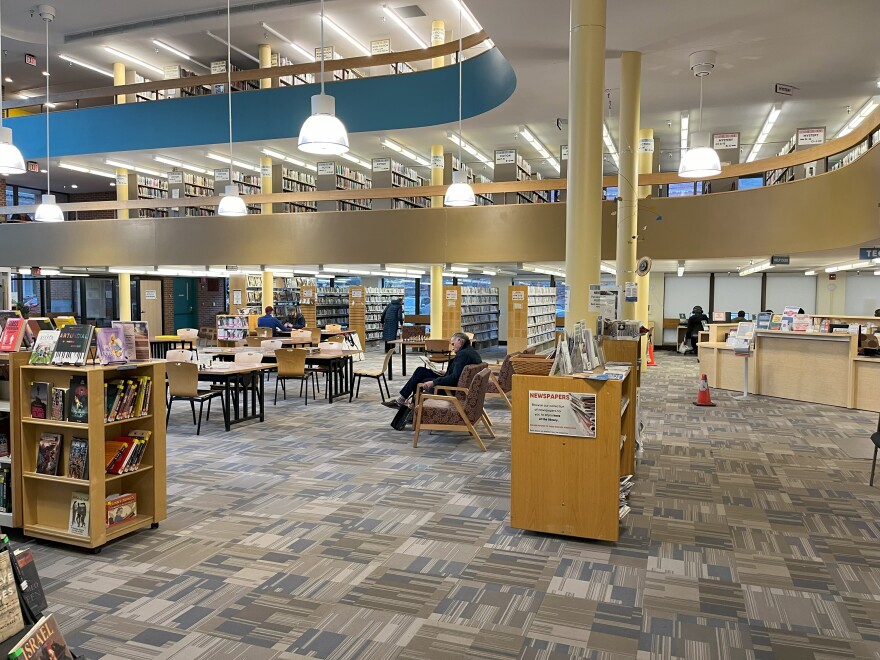
In Burlington, Vermont’s largest library, Fletcher Free, has also been responding to issues related to substance use. Mary Danko, their library director, said they started to offer harm reduction bags to patrons.
They include Narcan, an overdose reversal medication, fentanyl test strips, and they recently added a supply of xylazine test strips to the bags as well.
But offering these extra services requires more resources from the library.
“We’re being asked to do more and more and more,” Danko said. “What sometimes doesn’t go hand in hand with that is the funding.”
Some libraries are or would like to partner with social workers in Vermont.
“When there’s a high community need for something, it can be really beneficial to have a library and a service organization working together,” said Catherine Delneo, the Vermont state librarian and commissioner of libraries.
For many libraries, it’s not an option because of the expenses that come with standing up an additional social work unit.
In the meantime, many librarians say they want to help everyone who walks through the doors, but it can be really draining.
“Just come in and do as much as you can and do the best you can. Offer what you can, be honest when you can’t, and then, you know, go home and take care of yourself.”
Garrett Grant, assistant director of the Aldrich Public Library
“There’s been some times I’ve felt really defeated,” said Garrett Grant, the assistant director at the Aldrich Public Library.
He said he tries to set boundaries at work.
“Just come in and do as much as you can and do the best you can,” Grant said. “ Offer what you can, be honest when you can’t, and then, you know, go home and take care of yourself.”
This story is a collaboration between Vermont Public and the Community News Service. The Community News Service is a student-powered partnership between the University of Vermont’s Reporting & Documentary Storytelling program and community newspapers across Vermont.
Discover more from Vermont Daily Chronicle
Subscribe to get the latest posts sent to your email.
Categories: Vermonters Making A Difference







In a way this isn’t new. It’s just expanded to more places that didn’t have this problem before. I lived in the Boston area in the late 1980’s. Going to the main Boston library was a bit iffy because there were so many homeless people just camped out there all day; it basically was a day shelter.And I’d never have dared use the bathroom! I was in Wilmington NC in 2017 on a trip and needed to use a computer and printer. I got to the library early and lined up with a mass of homeless people, all waiting to go in, use the computer, bathroom, charge cell phones and hang out all day. The same thing in many other cities that have a homeless population. I think this all traces back to the closing of mental health facilities which has pushed people onto the streets where they use drugs and create unsafe conditions. One way or another we pay for this. I’d rather we paid for safe spaces where they would get treatment for their problems and had no access to illegal drugs.
Well, I confess, I am very out of touch with this aspect of the library. I live in a town without one so to check books out of the nearest town requires paying a fee…since I am already paying a fee for another service that offers books, I use that instead of the nearest library. This aspect never, ever would have occurred to me. How shameful that our society feels it is okay to abuse the local library in such a manner and make it so uncomfortable for regular patrons. Sometimes I can be so naive.
I’m sure I’ll get some push back on this thought, but I don’t care. This is just wrong but so indicative of our society.
If anyone reads this article and doesn’t grasp that our society is in rapid free fall, they are intentionally obtuse.
I feel a deep sense of mourning now that I’ve read this article. Deep.
Seems clear to me. The State subcontracted social services to public libraries without making it known that librarians are social service representatives on behalf of the State. Not in their curriculum or job description, but experience and qualifications are unnecessary details and not required in Pervmont[sic]. I’m sure there were backroom deals and agreements made to ensure the public library performs a civic duty at the bequest of the despots in charge, local and State.
The only thing that seems pretty clear to me is that now the Burlington City Council and “progressive” legislators will remain on their mission to defund the police, but demand that in addition to social workers responding to calls, they will want a librarian or two there on the scene as well.
That will finally solve everything —- Reading IS fundamental.
People go to the library because it’s one of the last spaces in our culture where there is no expectation of spending money. Since everything in society is privatized, where else are the most vulnerable to go?
You are really cracking me up Chris. I generally go to the library to borrow books, use the computer when I didn’t have my own and to see and photo copy historical documents like the original drawings of the Caladonia type face when I was in college in Boston. I also frequently visited a historical and amazing library called the Peobody Library in Baltimore, Maryland. I didn’t go there because these places was free. I went there because they were amazing. The examples I provided are why libraries should exist, not to house the homeless for free.
When I was a librarian in a major city library we did outreach to social service agencies by bringing books and staffing small on site libraries. That was 40 years ago. Many of the social service agencies no longer exist and their services moved to the libraries by default; why is that, you might ask? Is it the same moral decay and decline in values we see everywhere? Or the mindset that someone else will pay for it, like the mindset that exists in VT’s climate deal and school funding? Or is it the result of one of Dear Abby’s definitions of government types, or a combination of several:
Communism: You have two cows. The government takes both of them and gives you part of the milk.
Socialism: You have two cows. The government takes one and gives it to your neighbor.
Fascism: You have two cows. The government takes both cows and sells you the milk.
Nazism: You have two cows. The government takes both your cows, then shoots you.
Bureaucracy: You have two cows. The government takes both of them, shoots one, milks the other, then pours the milk down the drain.
Capitalism: You have two cows. You sell one of them and buy a bull.
One thing I’m sure of, no American who owns nothing will be happy.
I have to laugh at this. These wise librarians invited the drag circus to their library and this is what these fringe groups bring along as baggage. What did these smarter than thou groups think would happen when open your doors to insanity?
I so agree with you AZjim!
I heard the Aldrich library needle depository is taped together not because it’s old, but because someone broke into it to harvest the used needles. If I have the wrong impression, I’m sure someone will let me know.
Why the heck does a library have a needle depository?
so the custodians dont have to remove the used needles from the clogged toilets…
Chris is onto something. If everything was government, addicts would not have a way to buy drugs privately thru some private dealer. They’d have to suffer and go clean. Or use the illegal black free market…
Oh wait… LOL.
I’m a bit confused, isn’t public use of hard drugs illegal, even in Vermont? Now parents can’t take their kids to the library without having people shooting up next to them. Is this for real?
What’s next? Free tote bags provided by cashiers for shoplifters at the entrances of retail stores?
In regards to the drug use and overdoses in the libraries, if we just let Darwinism take control the demand for said drugs might just dwindle.
pervmont ///only one person dreamed up this word///
I respect most librarians, but not when they welcome offensive drag queens to read to innocent children…then they are part of a demonic coven.
It is unfortunate that the critics of our public libraries offer no practical solutions to the social ills that libraries are addressing as best they can. Kudos to our librarians and their staffs.
But of course there are practical solutions to these problems, our out-of-touch Dem/Prog legislators just refuse to countenance these solutions. We need a funded, working, available mental health system either community-based or regionally, hospital based. But the legislature is on an ideological, maniacal quest to save the climate with its costly efforts to electrify our energy sector with unreliable wind/solar systems . These efforts defy laws of physics and economics but they persist in their pursuit. VT spends vastly more per pupil for a public education system with no proven results that justify such spending. The legislature simply refuses to stop enacting the education union’s demands . There are many other examples of mis-spent Legislative priorities and thus we fail to have the monies for the problems this article discusses. The issue is not monies, the issue is priorities and Legislative will.
What you loose on the coconuts you make up on the bananas