

|
Getting your Trinity Audio player ready...
|
Also, Apollo moon rocks honor Artemis II at the Vermont History Museum

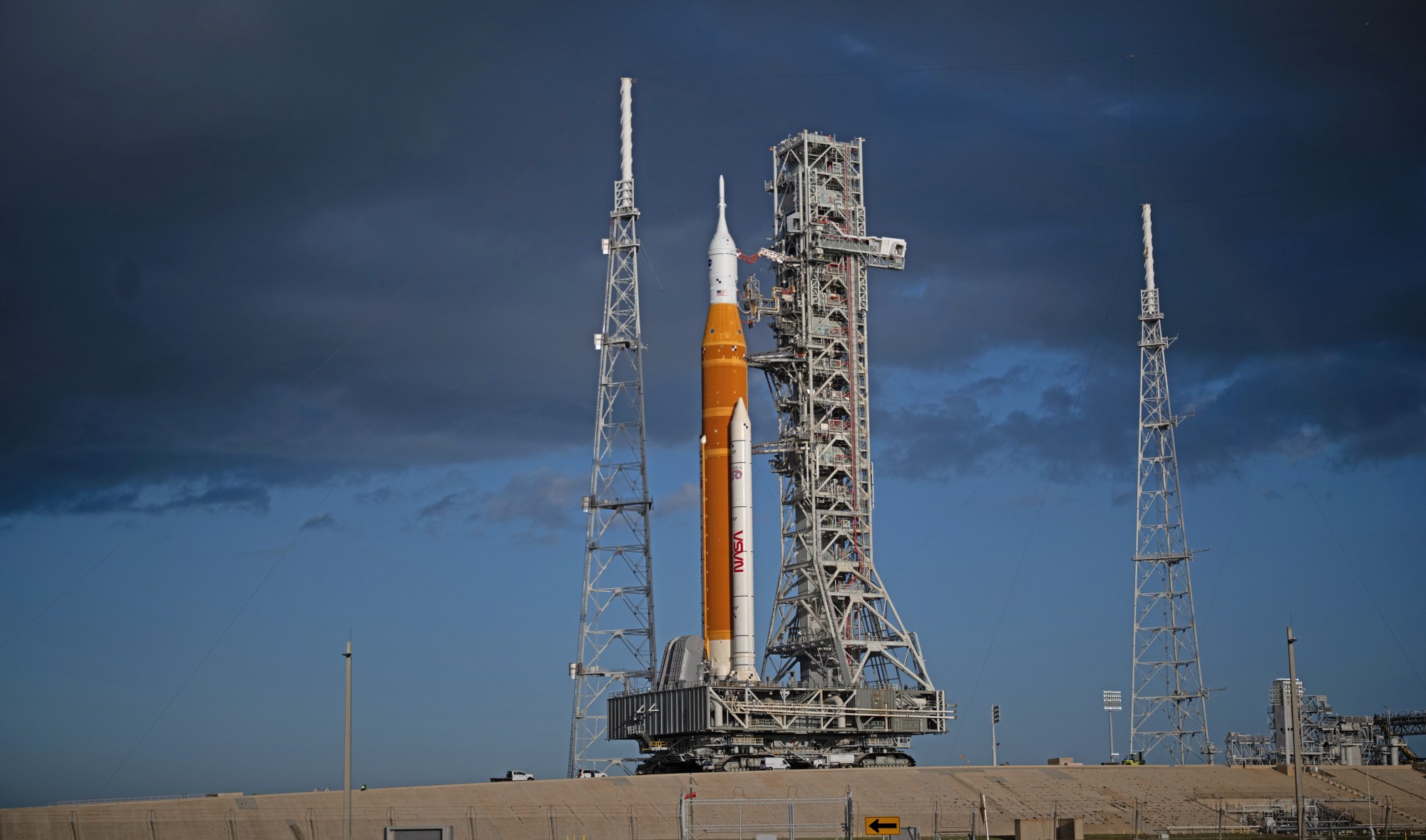
Photo: NASA/Joel Kowsky
By Timothy Page
As NASA prepares for the Artemis II mission—the first crewed lunar flyby since Apollo 17 in 1972—Vermont is showcasing its direct historical connection to the Apollo program through a special public display of rare lunar samples. At the same time, a Vermont-based engineering firm is contributing cutting-edge technology to support the broader Artemis program’s goal of sustainable lunar exploration.
Apollo 11 and Apollo 17 lunar samples on display in Montpelier
The Vermont Historical Society (VHS) is exhibiting two commemorative lunar sample plaques at the Vermont History Museum in Montpelier, specifically timed to celebrate Artemis II’s upcoming launch. The display opened to the public in early February 2026 and remained on view for several months.
The first plaque, from Apollo 11 (the 1969 mission that achieved the first crewed Moon landing), features four tiny samples of lunar basalt embedded in a clear resin sphere. Mounted below it is a small Vermont state flag that flew aboard the command module Columbia. The plaque’s inscription reads: “Presented to the people of the State of Vermont by Richard Nixon, President of the United States” and “This flag of your state was carried to the Moon and back by Apollo 11, and this fragment of the Moon’s surface was brought to Earth by the crew of that first manned lunar landing.”
The second plaque, from Apollo 17 (the final Apollo lunar landing in December 1972), includes a larger fragment of lunar basalt from the Taurus-Littrow Valley. This sample was part of a larger rock (cataloged as lunar basalt 70017) that was broken into pieces and distributed worldwide as the “Children of the World” rock—a symbol of unity. The plaque also displays another flown Vermont state flag and bears the text: “This fragment is a portion of a rock from the Taurus Littrow Valley of the Moon. It was part of a larger rock composed of many particles of different shapes and sizes, a symbol of the unity of human endeavor and mankind’s hope for a future of peace and harmony.” It continues: “This flag of your state was carried to the Moon aboard Spacecraft America during the Apollo XVII mission, December 7-19, 1972. Presented to the people of the state of Vermont by the National Aeronautics and Space Administration.”
These plaques were among the goodwill gifts distributed by President Nixon in the early 1970s to all 50 U.S. states following the Apollo missions. Vermont’s specimens have been carefully preserved by the VHS since their arrival.
Steve Perkins, executive director of the Vermont Historical Society, reflected on the public fascination with these artifacts: “Huge crowds of people turned out to see the rocks and also to see that command module. I mean, we have to put ourselves back in time. We didn’t have the internet or anything like that so you had to actually drive to Montpelier and be part of history.”
Full details and more background, including images of the plaques, are available on the Vermont Historical Society’s official blog post about the display.
Concepts NREC advances cryogenic technology for Artemis Lunar Operations
Beyond historical artifacts, Vermont industry is actively supporting NASA’s Artemis program through advanced engineering at Concepts NREC in White River Junction. The firm received NASA Small Business Innovation Research (SBIR) contracts to develop high-capacity helium-based reverse-Brayton cryocoolers essential for cryogenic fluid management on the lunar surface.
Cryogenic technology involves handling materials at extremely low temperatures — often hundreds of degrees below zero Fahrenheit — where gases like oxygen and hydrogen turn into dense liquids. In the context of the Artemis program, Vermont’s cryocoolers act like super-powered refrigerators: they chill and liquefy oxygen and hydrogen that NASA can produce from lunar ice. Without this cooling, the fuels would stay as bulky gas or boil away quickly in space’s heat, making tanks impractically large and wasting precious propellant. By keeping everything liquid and stable, the technology enables on-the-spot refueling of rockets, landers, and depots directly on the Moon — a key step toward building a sustainable lunar presence instead of hauling every drop of fuel from Earth.
In March 2022, Concepts NREC announced a Phase II SBIR award (following a Phase I selection in 2021) to design and demonstrate two high-capacity helium-based reverse-Brayton cryocoolers. The technology will form the basis of a novel integrated two-stage helium system capable of liquefying both liquid oxygen (LOx) and liquid hydrogen (LH2) produced from lunar resources. NASA estimates the system needs to provide more than 330 W of cooling at 90 K and 130+ W at 20 K to support at least 11.7 metric tons of propellant per year—dramatically increasing current space-based cryocooler capacity by an order of magnitude.
The cryocoolers leverage turboalternator powertrain technology upgraded for lunar surface conditions. This enables in-situ resource utilization (ISRU): mining water ice at the lunar poles, converting it to oxygen and hydrogen via electrolysis, and storing the propellants as liquids.
Mark Anderson, Chief Technology Officer at Concepts NREC, stated: “Concepts NREC is honored and excited to continue our work with NASA in support of the Artemis missions. In collaboration with commercial and international partners, our innovative cryocooler solutions will allow NASA to establish the first long-term presence on the Moon and to explore, harvest, and transform natural resources from the lunar surface. Then, NASA will use what they learn on and around the Moon to take the next giant leap: sending the first astronauts to Mars.”
He added: “Artemis is the first step in the next era of human space exploration. The team at Concepts NREC is proud to play a role in the development of key systems and technologies to allow astronauts and robots to conduct ground-breaking lunar research and to set the stage for space exploration to Mars and beyond for decades to come.”
A detailed project announcement is available here: Concepts NREC announcement of the Phase II award.
Together, Vermont’s Apollo-era moon rocks and modern cryogenic innovations bridge the gap between humanity’s first steps on the Moon and the Artemis era’s ambition to stay and explore. For the latest on the museum display, visit the Vermont History Museum page.

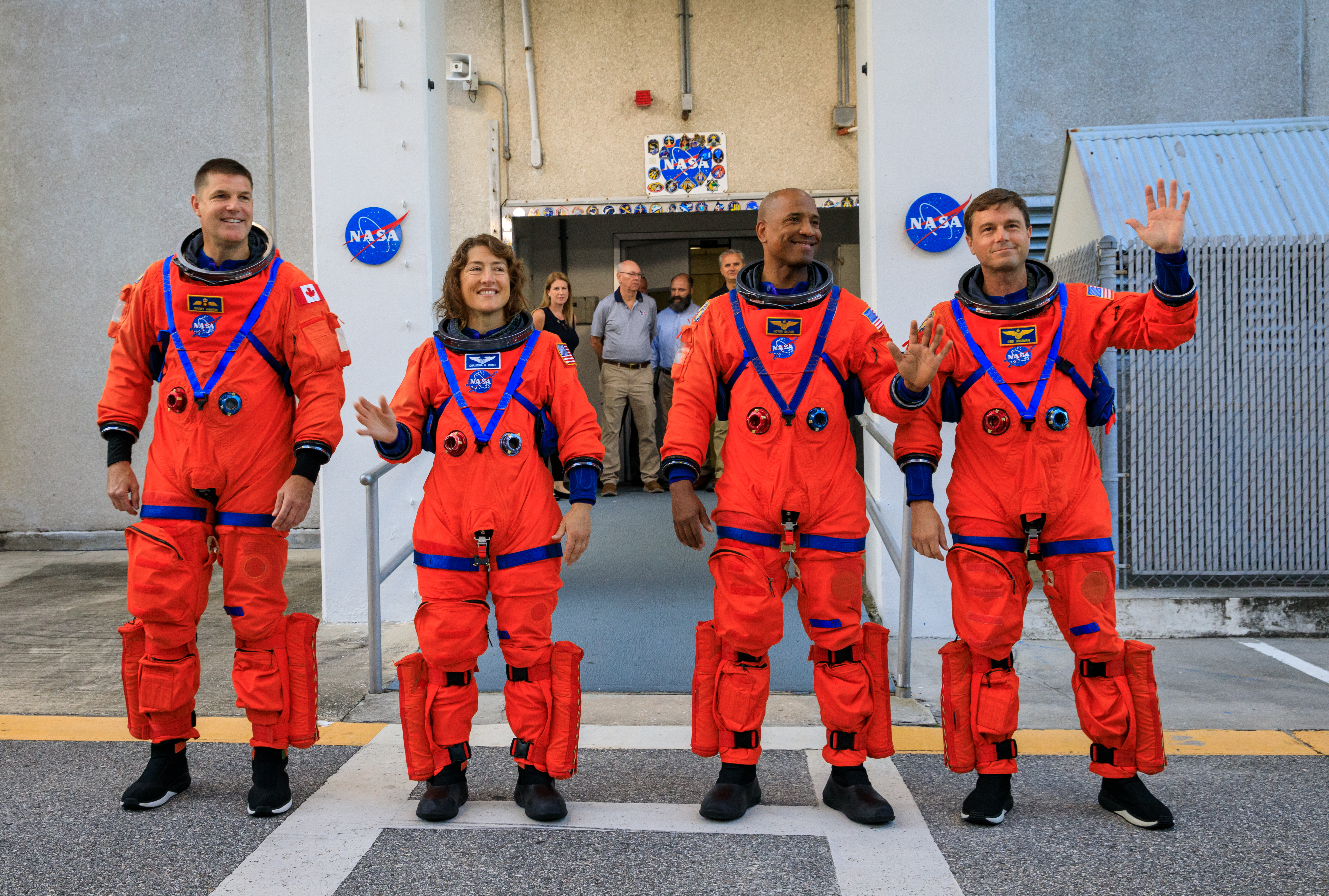
Photo: NASA/Kim Shiflett
NASA is currently targeting launch of Artemis II for Wednesday, April 1, 2026, at 6:24 p.m. EDT, with a two-hour launch window from Kennedy Space Center’s Launch Complex 39B in Florida. The countdown clock began on March 30, and the weather forecast shows an approximately 80% chance of favorable conditions, though cloud coverage and ground winds remain the primary concerns. Backup opportunities exist daily through April 6, with another window on April 30 if needed. The roughly 10-day mission will send astronauts Reid Wiseman, Victor Glover, Christina Koch, and Jeremy Hansen on a loop around the Moon to test Orion spacecraft systems ahead of future surface landings.
Discover more from Vermont Daily Chronicle
Subscribe to get the latest posts sent to your email.
Categories: Business, Science and Technology, Space





Maybe this time they may get to the moon.
Hard to believe that no human has left Earth orbit since the last Apollo mission
in 1972…over 50 years. It’s a ballsy thing to do, to be shot out away from Earth’s gravity and put your faith in the equipment and the engineers to get you back.
Good article. No mention of Beta Industries or Elon Musk.
Interestingly no mention of those private individuals funding the mission