

|
Getting your Trinity Audio player ready...
|
My annual backwoods project to collect winter feed

by John Klar, Small Farm Republic
Often in my childhood when driving with my mother, she would point to a truckload of hay and say “Make a wish! Whenever you see a hay truck you should make a wish!” Wishing is the secular counterpart to praying, and my mom, born and raised a short distance from where I now write this essay, was shaped by a frugal, agrarian culture in which a full load of quality hay was regarded as a blessing or gift.
And so it is. My wife and I made our own square-bale hay for years in Vermont’s Northeast Kingdom, where we usually put up between 6-9,000 bales each year with the help of our young children and a few beer-fed farmhands. Now I gather hay from various farmers (at $4-$7/per bale, rather than the $2-$3 we received two decades ago). This is an enterprise I wish to share.
I work hard writing on the computer with my brain while my body atrophies. Farming and collecting winter feed is my gym membership, my therapy, and my social circle. I meet farmers all over central Vermont in search of the best hay at the best price. I buy first cut and second cut, which have different purposes; I buy both square bales for our sheep and round bales for our cows. Some hay is delivered; some I get in the winter from the farmer’s barn, or off the fields in the summer.
I get to drive over beautiful Vermont dirt roads under a glorious Vermont sky on steep, stoic mountainsides in my $2,500 pick-up (four years ago!). The truck has a sound frame, new brakes, and a reinforced spring package so it can endure the abuse. I seek to load as many bales per trip as I can safely, and without breaking a leaf spring or otherwise killing my work truck. This is the most efficient for time, gas, and vehicle wear — but it also makes for a fun challenge during physical labor.
They don’t plan to be haying in two decades, if they are here at all. And almost no one young is taking up the hard work, costly equipment, and extensive knowledge required to continue supplying the hay market — let alone land and tax costs. As I tool around these Green Mountains in my rust-bucket Dodge, I realize that the life expectancy of our rural agricultural culture mirrors that of my transportation — it is running on duct tape and old men.
So, too, with the deteriorating ghostly farm buildings still clinging to the Vermont hillsides. The old barn where we now rent was last dairied in 1959 by the Trask family. (My mom used to stay here as a child; her best friend was Lydia Trask). In order to get all my accumulated hay collection in the barn I must drive over uneven ledge and soft manure, but I basically have a free barn to use: we are reclaiming the building to repurpose it for our flock of sheep.
An old farming adage says “The best way to preserve a barn is to put animals in it.” There is truth in this, though (farmer) theories as to why vary. The barn swallows and other bird life also return when the animals do — it is not the barns that draw them so much as the insects feeding on cows and their manure. We have collected over 1200 square bales to reclaim that barn this winter, and are running a new water line from an 1850s spring for the sheep. They will be stylin’!
Alas, there is no electricity in the barn, and thus no lights and no power for a hay elevator. I could use a small generator, but where would be the fun (and exercise) in that? I have loaded many truckloads this year off farmer’s fields, often handling the hay twice — once onto the truck, and then I climb on and stack it. Then I unload it into the barn — one time off the truck, another throwing it up the pile, and a third (or fourth) time to the top for tight winter stacking. A tight stack keeps the vermin and weather out, and preserves feed freshness and nutrition for the sheep.
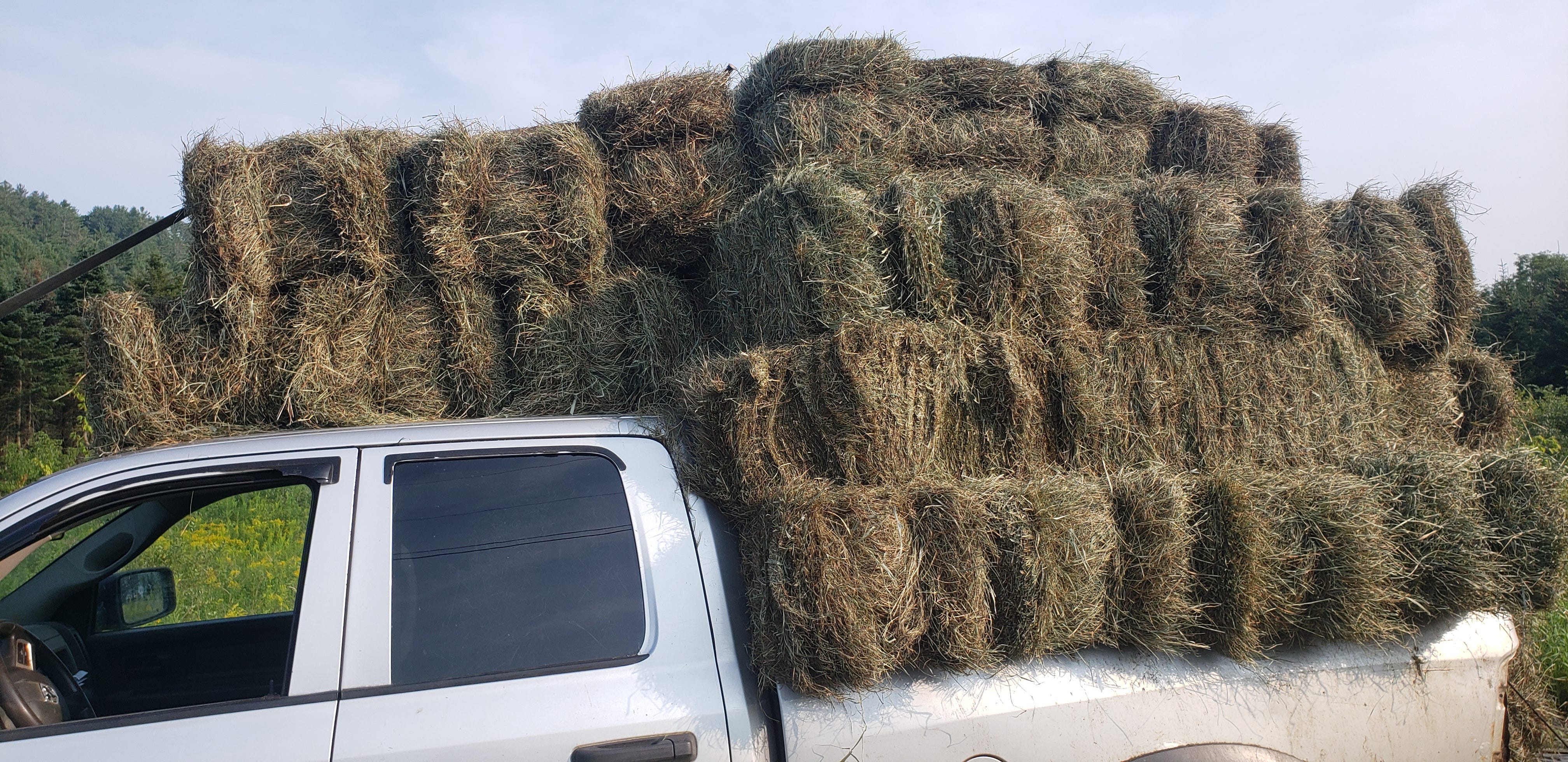
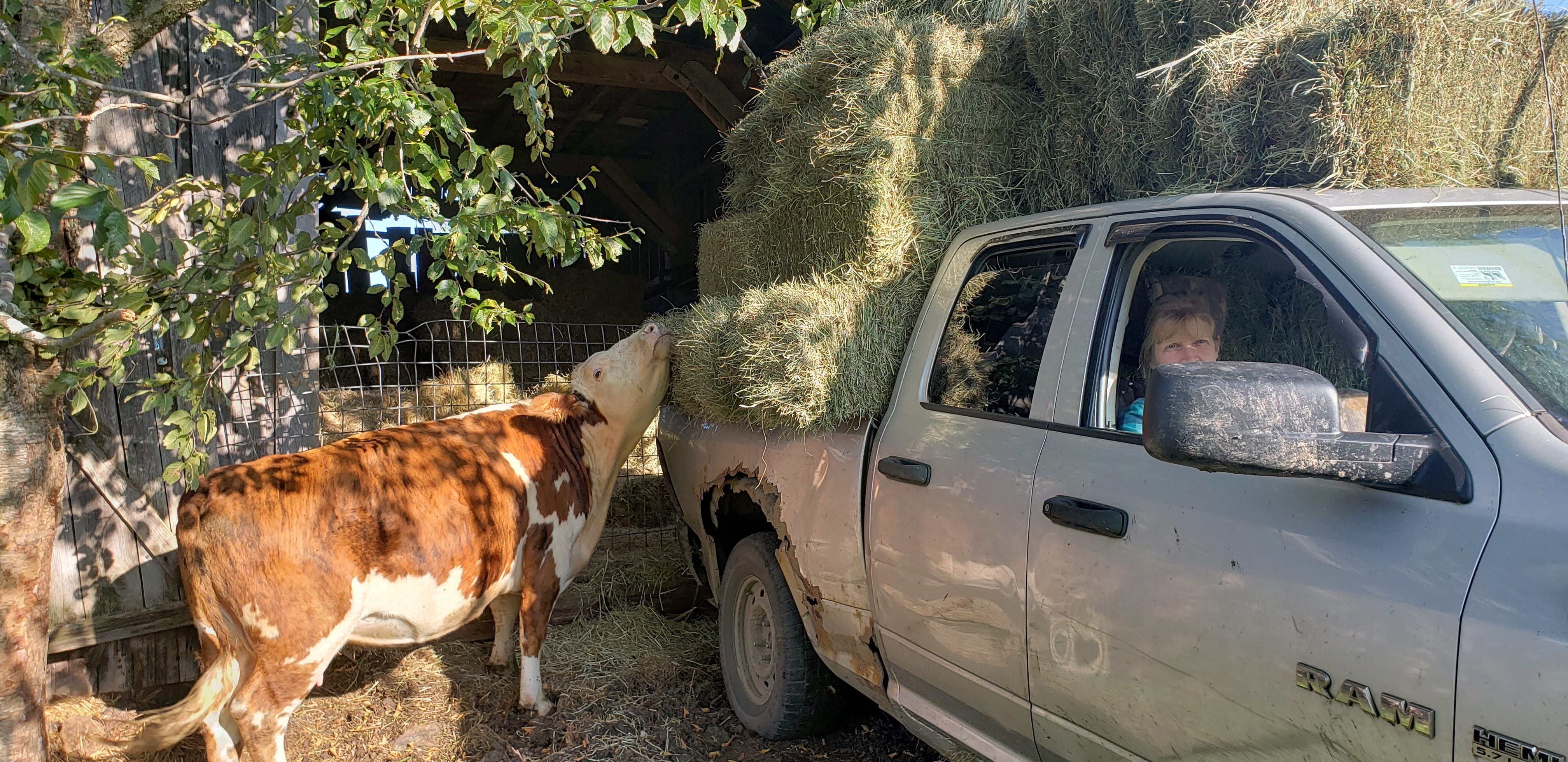
In the top picture above, a farmer had delivered a wagonload of 168 bales in the morning. I backed my truck up to the trailer and loaded 56 bales, throwing them aboard and then stacking them neatly. It had rained moderately two nights before, and as I surmounted the usual obstacles of ledge and boulders beside the barn, I hit a wet manure patch, and the truck (permanently locked in 4-wheel-drive) bounced and spun its wheels in place. Behind me on the ground were 23 of those beautiful, 45-pound second-cut bales; behind them were several eager cows.
I couldn’t back up or go forward with the truck, only jump out and start hauling the grounded bales, two-by-two, up the muddy hillside and throw them near the back door of the barn. I grabbed some sweet feed to distract the cows to buy myself some time as I scurried, stumbling and sweating, to collect the downed bales by the barn before hopping back into my trusty truck. I was able to maneuver the rig in a tight backward turn where it grabbed solid ledge, then pulled up above the barn and backed up to unload the remainder.
Read the rest at Small Farm Republic
Discover more from Vermont Daily Chronicle
Subscribe to get the latest posts sent to your email.
Categories: Agriculture





Re: “my $2,500 pick-up (four years ago!)”
Surely, you meant to ‘type’ $25,000 pick-up. Otherwise, I’ll triple that $2500 price tag you spent and buy your truck tomorrow. 🙂
Jay… plenty of us drive cars that are 10 years and older for a reason… they are cheaper, for one, tend to outlast newer versions, and our local mechanic can fix them faster… plus…they go and go and go…who told you you had to pay over 25k for a truck to last four years, and it had to be new?
I once drove a Subaru I bought for 200 dollars to and from AK from VT, twice… I haven’t paid over 2k for a car in… oh, 50 years…nearly all of them reached 200k miles… just sayin’…
No need to lecture me on the value of old cars. My 1999 pickup has 130,000 miles on it and is still going strong. I bought it 15 years ago for $9000+-. My Volvo wagon is 16 years old with 210,000 miles on it. Had to spend $5000+ for front wheel bearings and breaks last month. You couldn’t replace the brakes on Klar’s pickup for $2500 today.
I enjoyed reading this article and the reality of how hard farmer’s work. It’s unfortunate that the majority of our, out of state invasive legislators probably have no idea of the life, dedication and hard work of the rural farmer.
They instead get dressed in their neat clothes, accumulate in the people’s house and dream up ridiculous restrictions, insane laws, fees, taxes and whatever else they can come up with to make life more difficult than it already is for the people providing the subsistence for the rest of us.
Our historical legislators of which many were Vermont generational farmers, knew and understood the unique balance between nature and life. Vermont was a much better place when there were more cows than people, when small farms were in abundance throughout the state and the quality of life here so much better before the influx of busy bodies and the control fanatics arrived to take care of us.
Take back Vermont is more than a slogan painted on barns visible from our roads. It’s a reminder for those of us who were lucky enough to be born and raised here before the so-called intelligent, educated fools arrived to help us.
Places still exist where there are no people to mess things up. Take Back Vermont Back Vermont is much more than a dream that once existed, it’s means just as much today as the day it was first painted on the first barn wherever that was. For me, this article brought my mind to those long, lost days back to a much better time in Vermont. While we can’t stop progress, we as voters can stop the insanity coming from Montpelier. Voting for common sense means changing your vote. It’s the only act we can do to rescue the future of Vermont for our farmers and for the rest of us.