


Setting up election steals: Part one

by Joe Gervais, in Vermont Musings
Introduction
Recently, Rob Roper wrote If you really care about Donald Trump, don’t let him be the Republican nominee. Throughout the article, there was no mention of corruption to our election system, rather just calling out that Trump did not beat Biden in 2020 and that he did not help Republicans win in the Georgia 2021 runoff. Three years later, Trump has a very strong policy platform in his Agenda 47, but also is not letting go of the theft of our elections. His continued amplification of the election integrity issues is a key factor in both the most recent federal indictment by Jack Smith and the Georgia indictment by Fani Willis against President Trump. If we do not have free elections, we do not have a republic, and millions of Americans have woken up to that fact.
In August, I attended the Election Crime Summit in Springfield, MO. Videos from the two-day event are available on FrankSpeech. Representatives from all 50 states were in attendance and gave updates on the state of elections in each of their states.


Vermont’s State Constitution, Article 8 states: That all elections ought to be free and without corruption, and that all voters, having a sufficient, evident, common interest with, and attachment to the community, have a right to elect officers, and be elected into office, agreeably to the regulations made in this constitution. Federal Election law specifies the standard for without corruption – less than 1 in 125,000 or .0008% ballots in error.
The topic of Election Integrity is one that books can be written. I will publish a four-part series Part One – Voter Rolls: The Election Fraud Credit Line, Part Two – Using Centralized Management to Drive the Results, Part Three – Where does Vermont Stand? and Part Four – Solutions to Restore Safe Elections.
Expansion of Voter Rolls
When we dissect elections, we first need to look at voter rolls. The dirtier the rolls are, the more room for fraud and illegal activities in elections. Wisconsin has nearly two voters on the rolls for every legal age adult in the state. Vermont is one of seven states in the country with 100% registration rate. As Dr. Douglas Frank said in this presentation during the Summit, the voter rolls are the credit line for election fraud. The greater number of voters above legitimate registered voters on the rolls, the greater the opportunity for fraud. In a later presentation, Dr. Frank showed how much easier it is to stuff ballots to get a desired result than to remove votes to obtain that result – turning a 10% win into a 4% loss takes 8% additional votes to flip yet requires suppressing 14% of the vote to get a similar result by suppression. This is why having dirty voter rolls is so critical to election fraud. In each of the 46 states Dr. Frank has analyzed, including Vermont, the voter rolls are growing significantly faster than the underlying population growth of voting age adults, and furthermore, the pattern of growth is identical across counties, with significant growth before elections and purges immediately after elections.
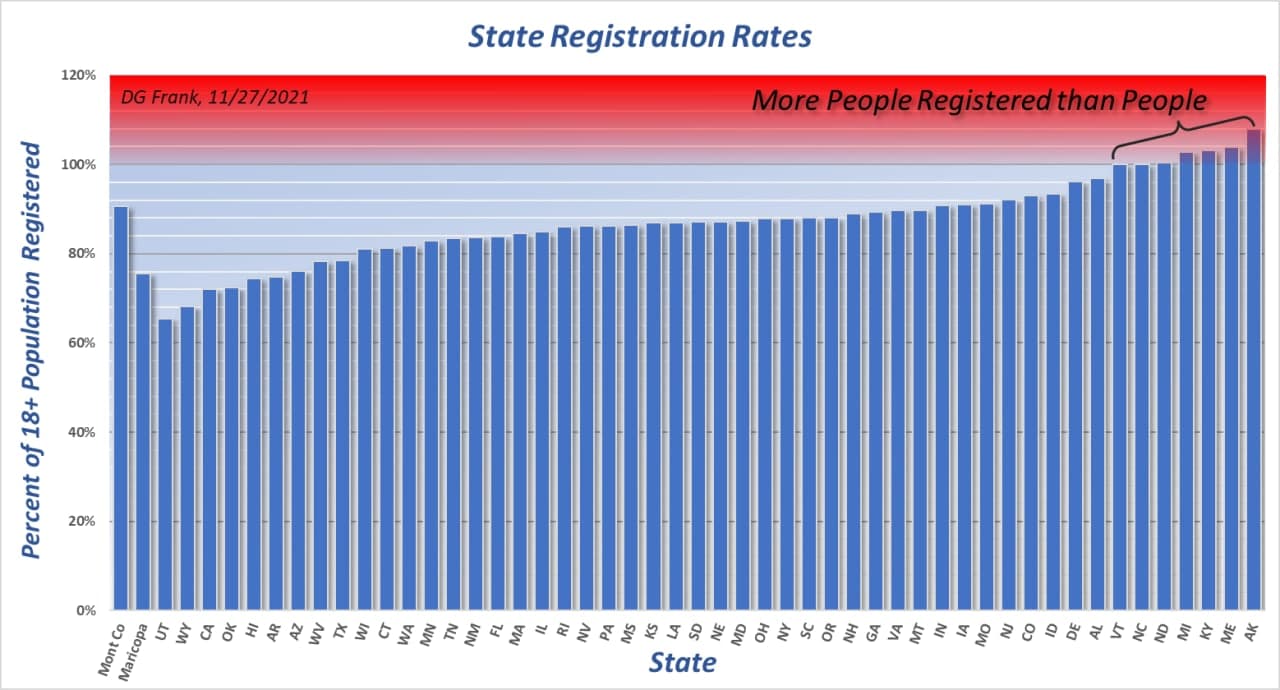
In his presentation, Dr. Frank spoke of a meeting with the head clerk in the State of Missouri. The clerk acknowledged that tens of thousands of ballots are being stuffed. When asked why county clerks aren’t aware of this, the clerk stated “If we told the clerks how many ballots were being stuffed in our elections, the whole state would blow up, and everyone would lose faith in our elections.”

The Electronic Registration Information Center
A number of states are members of the Electronic Registration Information Center (ERIC). ERIC is a Soros funded, state-run voter monitoring system in which states periodically submit their voter rolls for review to purportedly identify incorrect and outdated voter information. Its membership consists of state-level election officials from member states. In the past year, nine states including Alabama, Florida, Iowa, Louisiana, Missouri, Ohio, Texas, Virginia, and West Virginia have withdrawn from ERIC over a number of concerns. Arizona attempted to withdraw, but the legislation was vetoed by Katie Hobbs. In Virginia’s withdrawal from ERIC, Virginia cited concerns related to the sharing of data with outside organizations leveraged for political purposes. Some states objected to the membership requirement to contact would-be voters who may be eligible to register but haven’t registered.
Ken Blackwell, Chair of the Center for Election Integrity at the America First Policy Institute (AFPI) issued a statement following the Texas withdrawal from ERIC. He stated, “ERIC was initially sold as a non-partisan data system to clean voter rolls. However, it has been transformed into a system that lacks transparency, compromises voter information, and focuses on states registering voters rather than cleaning voter rolls.” He recommends “Secretaries of State who are still members of the system should conduct an immediate review of ERIC’s effectiveness and validity for their states and voters.”
Retired Air Force Colonel Shawn Smith has a short video for Cause of America where he describes some of the issues of a private organization like ERIC having influence over voter rolls without oversight. In recent Supreme Court decisions like West Virginia vs. EPA, we’ve seen the court rule that Executive Branch agencies cannot make laws, that is the role of the legislature. Here we see government, at both the state and federal level outsourcing critical operations on critical infrastructure to private, outside organizations, and in some cases, foreign organizations, with little to no oversight.
Voter rolls have been steadily growing across the nation since the passage of the National Voter Registration Act in 1992. This was an era where the general population and municipalities started more widely using computers with Internet connectivity following the development of the world-wide web three years earlier by Tim Berners-Lee at The European Organization for Nuclear Research (known as CERN) in Geneva, Switzerland, and the release of the Netscape web browser in 1994.
Judicial Watch has been pursuing litigation against some of the most egregious dirty voter rolls, and won a settlement to remove 1.5 million entries from the Los Angeles County rolls. Unfortunately, it is usually mere months after a litigation win with an order to remove illegal registrants, that the voter rolls return right back to where they were. These dirty voter rolls work hand in hand with lack of Voter Identification requirements in many municipalities, and a widespread lack of chain of custody and signature verification for mail-in ballots and ballot drop boxes.
Stay tuned for part two where we’ll explore some of the pieces used to provide a pre-determined election outcome.
Joe Gervais is a former Army Officer with an eclectic career ranging from decades in Sales and Marketing in the tech industry to running a sawmill and serving the global church as a missionary.