


By Guy Page
The Burlington City Council B/D/S resolution against Israel suffered a last-minute, humiliating loss Monday night.
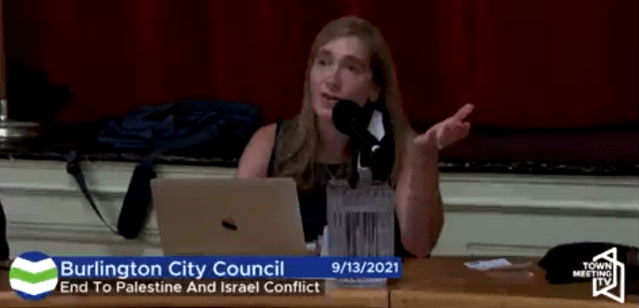
Poised to become the first city in the nation to approve the boycott, divestment and resolution of Israel at the behest of pro-Palestinian activists, the Council instead withdrew the resolution after extensive criticism. The vote was 6-5, and the five “no” votes were councilors who wanted a decisive vote to kill the resolution once and for all. According to media reports, the vote followed lengthy, lively discussion. Press photos show community members on both sides carrying signs and banners during the public meeting in Contois Auditorium of Burlington’s City Hall.
Support for the resolution began to crumble when after sponsor Ali Dieng announced Monday afternoon he would withdraw it, Asaf Shalev of the Jewish Exponent reported:
Dieng said that conversations he had with community members in recent days changed his mind and led him to believe that BDS is “one-sided” and that it contributes to antisemitism.
“A lot of community members who are Jewish have been experiencing antisemitism for a very long time and I didn’t know about it,” he said in an interview. “We are a small community and I want to make sure everyone feels safe. Many people [who supported the resolution] are not happy with me, but I think it is the right thing.”
Mayor Miro Weinberger also announced his opposition in a press release Monday: “While I support efforts to advance full equality and human rights for all and am deeply troubled by the current status of Israeli-Palestinian relations, I cannot support the Resolution that has been submitted to the City Council for action tonight. Specifically, I oppose the boycott, divestment, and sanctions (BDS) movement that seeks to weaken and delegitimize an important and long-standing partner of the United States, the democratic State of Israel.”
Weinberger also criticized the timing of the vote on the resolution, which would have fallen between the sacred days of Rosh Hashanah and Yom Kippur, Shalev wrote.
He also noted that “in the lead-up to the anticipated vote, many leaders of the state’s roughly 7,100-member Jewish community organized to defeat the resolution. They sent letters, authored petitions, and hired a communications firm.”