

by Guy Page
Just two weeks after the Essex-Westford School District diversity director called Critical Race Theory (CRT) an “important aspect” of its equity and inclusion program, the school superintendent denied the district has a CRT curriculum. However, an analysis of the school budget suggests otherwise.
“The EWSD is not implementing a “critical race theory” curriculum. The District has not spent funds on any such program,” Superintendent Beth Cobb said in a published overview of the May 18 school board meeting. She added in a subsequent statement, “Equity is not a specific curriculum. Equity is not a specific purchase in the budget. Equity is not only one person’s job. Equity can not be described in a checklist. Equity touches all of our educational offerings, operations, and facilities. Equity is the foundation of our vision. Equity is an outcome.”
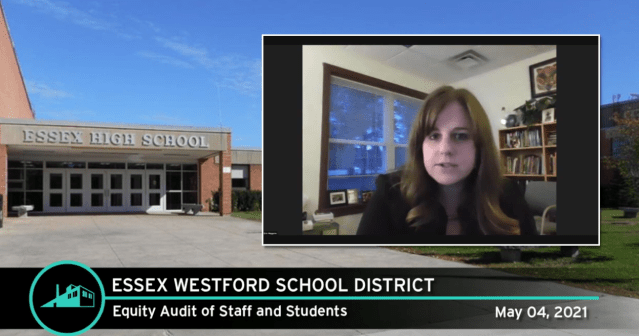
This statement is a stark contrast to assertions made at a May 4 school board meeting by Erin Maguire, Director of Equity and Inclusion.
“I do think that Critical Race Theory is an important aspect of the academic construct,” Maguire said in response to this question by newly elected board member Elizabeth Cady: “in order to fully achieve equity in the school, it has to be decided, that everyone accepts, that the United States is systemically racist?”
Maguire was reporting on her Equity Audit of staff and students. Her complete answer to Cady’s question appears at the 1 hour, 18 minute mark in the video recording of the Zoom meeting: “I do think that Critical Race Theory is an important aspect of the academic construct, as we consider the impact of race in our community, in our state, and in our country,” Maguire said.

“I do think that Critical Race Theory is an important aspect of the academic construct.” – Essex Director of Equity and Inclusion Erin Maguire, May 4


“The EWSD is not implementing a ‘critical race theory’ curriculum. The District has not spent funds on any such program.” – Superintendent Beth Cobb, May 18
Both the May 4 and May 18 regular scheduled meeting was well-attended by Essex citizens concerned about the extent of influence of CRT, as was a special meeting called to discuss a citizen ‘conflict of interest’ complaint against Cady, whose probing questions continue to bring to light the extent of CRT in the school district. The complaint was dismissed.
The school district is spending a lot of money on programs not labeled as Critical Race Theory, but which are indeed Critical Race Theory. Courageous Conversations is one of these programs, teaching students that systemic racism is why some cannot achieve and why others have privilege. The SEL (Social Emotional Learning) program – in which students are instructed to talk and write about their white supremacy, the similarity of police brutality to lynching, and the need to keep race in the forefront of every conversation – is also another Critical Race Theory program. EWSD is using CASEL, which is aimed at “redistributing power to promote social justice.”
According to a citizen analysis of this year’s budget presentation, EWSD will spend over $1 million on Critical Race Theory-based programs:
Courageous Conversations Whole System Plan – $30,000
Culturally Sustaining Pedagogy Training All Teachers – $30,000
Material Purchasing – $10,000
Stipends for Affinity Group Feedback and Focus Forums – $10,000
Multicultural Helpdesk – $40,000
Other Professional Development – $20,000
Equity Coach at EHS – $100,000
Equity Consultation Services – $20,000
SEL Coaches – $700,000
Purchase of SEL Curriculum – $82,000.
What is Critical Race Theory?
The following is excerpted from an essay by Christopher Rufo in the March, 2021 issue Imprimis, a publication of Hillsdale College:
“Critical race theory is an academic discipline, formulated in the 1990s, built on the intellectual framework of identity-based Marxism. Relegated for many years to universities and obscure academic journals, over the past decade it has increasingly become the default ideology in our public institutions. It has been injected into government agencies, public school systems, teacher training programs, and corporate human resources departments in the form of diversity training programs, human resources modules, public policy frameworks, and school curricula.
“There are a series of euphemisms deployed by its supporters to describe critical race theory, including “equity,” “social justice,” “diversity and inclusion,” and “culturally responsive teaching.” Critical race theorists, masters of language construction, realize that “neo-Marxism” would be a hard sell. Equity, on the other hand, sounds non-threatening and is easily confused with the American principle of equality. But the distinction is vast and important. Indeed, equality—the principle proclaimed in the Declaration of Independence, defended in the Civil War, and codified into law with the 14th and 15th Amendments, the Civil Rights Act of 1964, and the Voting Rights Act of 1965—is explicitly rejected by critical race theorists. To them, equality represents “mere nondiscrimination” and provides “camouflage” for white supremacy, patriarchy, and oppression.
“In contrast to equality, equity as defined and promoted by critical race theorists is little more than reformulated Marxism. In the name of equity, UCLA Law Professor and critical race theorist Cheryl Harris has proposed suspending private property rights, seizing land and wealth and redistributing them along racial lines. Critical race guru Ibram X. Kendi, who directs the Center for Antiracist Research at Boston University, has proposed the creation of a federal Department of Antiracism. This department would be independent of (i.e., unaccountable to) the elected branches of government, and would have the power to nullify, veto, or abolish any law at any level of government and curtail the speech of political leaders and others who are deemed insufficiently “antiracist.”
“One practical result of the creation of such a department would be the overthrow of capitalism, since according to Kendi, “In order to truly be antiracist, you also have to truly be anti-capitalist.” In other words, identity is the means and Marxism is the end.”
Alternatives to CRT are supported by FAIR, a national racial justice organization getting started in Essex Junction.
Contribute to Vermont Daily Chronicle via Stripe.com – quick, easy, confidential