


By Guy Page
Underground Railroad mural artist Samuel Kerson is suing Vermont Law School over its plans to cover up the 1994 work that some at the school say is racist.
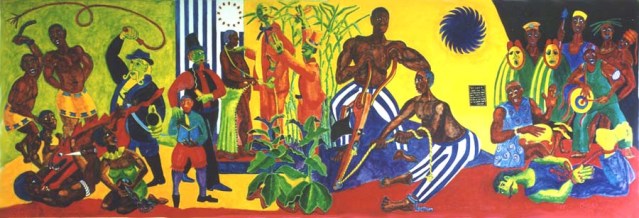
In a suit filed Dec. 7 in Vermont Superior Court, Kerson decries the state’s only law school’s plan to destroy, distort, mutilate or otherwise modify two murals, each 8′ x 28′, entitled “Vermont, The Underground Railroad and Vermont and the Fugitive Slave.”


According to the suit, the murals depict Vermont’s efforts to help slaves seeking freedom in the years before the civil war. Notwithstanding their nationwide recognition, in July of 2020, VLS announced that because of some complaints by students, who apparently found the murals “offensive”, it was going to paint over the murals. When Kerson learned of this, he advised VLS that he did not consent to destruction of his art and asserted his rights under the Visual Artists Rights Act (VARA). Nevertheless, VLS, purporting to give notice to Kerson to remove his art, informed Kerson that it intends to permanently cover the murals with acoustic tiles.
After the July announcement, Vermont Law School gave Kerson 90 days to remove the artwork. Kersson refused and filed suit instead, seeking an injunction to prevent the destruction. Kerson is a well-known Artist In Residence at institutions on both sides of the Atlantic. His works have been shown at the Vermont Supreme Court gallery, among other Vermont venues.
According to the suit, the murals depict the history of slavery including the capture and shipment of Africans to the Americas, the selling of captured humans in slave markets, the slave’s work condition, the suppression of African culture, abolition, resistance to slavery, featuring important historical figures, and the Underground Railroad.
The depictions of Africans, slavers, and white slaveowners and abolitionists struck a wrong chord with a VLS diversity committee, which successfully petitioned school leadership to order the mural painted over. VLS President Thomas McHenry reportedly informed the school community in this July email. “However, the depictions of the African-Americans on the mural are offensive to many in our community and, upon reflection and consultation, we have determined that the mural is not consistent with our School’s commitment to fairness, inclusion, diversity, and social justice. Accordingly, we have decided to paint over the mural.”


The July 8 Valley News article in which McHenry’s comment is cited above also reports mural critics want a new mural to be painted by a black artist. That news upset black Brattleboro physician and artist Dr. Thom Namaya, who authored a recent letter in VT Digger: “This magnificent mural is the exact opposite of racist. It is a beautiful and tragic mural depicting the insanity of slavery. It is also an homage to the brave Vermonters of all races who fought against slavery and supported the Underground Railroad. How perversely racist it is to say that this mural is racist because the principal artist was not African American. The team that helped to create this mural was a multiracial team, including the African American artist Kenny Hughes.”
According to a VermontVacation.com’s page on the African-American Trail, in 1995 a study examined scores of individuals and sites that were thought to have assisted in the transport of African Americans seeking freedom. Research identified 57 individuals, families, structures and buildings as being involved – or likely to have been involved – in the Underground Railroad.
Among those Vermonters who sheltered fugitive slaves were Quakers, free Black Vermonters, clergy members and a Secretary of State.
The phrase “Underground Railroad” began surfacing in Vermont newspapers and written correspondence as early as 1840. Evidence seems to indicate Underground Railroad efforts in Fugitives were helped between houses by word of mouth and the strength of Vermont communities, often carrying letters explaining where they came from and what they needed. Many settled in Vermont for good, enriching the state’s communities and economies.
To learn more about the documentation of Vermont Underground Railroad sites, download an excerpt from Friends of Freedom: The Vermont Underground Railroad Survey Report (State of Vermont, 1996.)
- Three Vermont counties identified as potential destinations for immigrant resettlement
- VT Headlines: Person rescued from cliff near Winooski River Gorge
- Heroin user whose driving killed two teens admits more probation violations
- $60.3 mil federal funding announced to upgrade Burlington-Bennington rail corridor
- Regulated trapping seasons open October 24
-
-
Vcurtishuntergergmail.cm I will respond to your statement in full when next speak on YOUTUBE (@brianpearl4695} (10/26/26)
-
Thanks Neil. It’s Too Bad, But It’s Not Too Late…
-
vcurtishuntergmailcom Orrrrr…as a more immediate 3rd possible option; Encourage school folk to take the protection of their students seriously…arm yourselves.
-
Jim Peters i will respond to your statement in full 10/26/26 when speak next on YOUTUBE @ (brianpearl4695)


Vcurtishuntergergmail.cm I will respond to your statement in full when next speak on YOUTUBE (@brianpearl4695} (10/26/26)