


The untold connection between transgenderism and Body Integrity Identity Disorder
By Timothy Page
In recent years, our society has witnessed a dramatic rise in people identifying as transgender. At the same time, many conservatives have raised important questions about whether all cases labeled as “gender dysphoria” are being properly diagnosed. Much like AD/HD and Autism were once (and perhaps still are) the diagnoses in vogue, Gender Dysphoria has become the pop-diagnosis of the era. This article explores the striking similarities between gender dysphoria and a condition called Body Integrity Identity Disorder (BIID), and why some experts believe many people suffering from gender confusion might actually be experiencing BIID instead.
What is Gender Dysphoria?
Gender dysphoria is a condition where someone feels intense discomfort with their biological sex. The current medical establishment typically recommends “gender-affirming care,” which can include changing one’s name and appearance, taking cross-sex hormones, and even undergoing surgeries to remove or modify healthy body parts.
This approach has become increasingly common, despite concerns from many medical professionals about its long-term consequences, especially for young people. As Dr. Stanley Goldfarb, former associate dean of curriculum at the University of Pennsylvania School of Medicine, noted in 2023, “The scientific evidence to support these interventions [for children] is remarkably weak.”¹
What is Body Integrity Identity Disorder (BIID)?
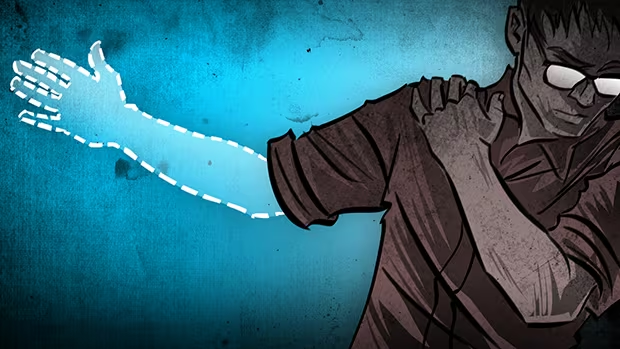
BIID is a rare condition where perfectly healthy people feel that one or more of their limbs or body parts don’t belong to them. They experience a powerful urge to amputate or disable these healthy body parts to match their internal sense of who they are. In 2022, researchers described BIID as “a condition in which individuals experience a mismatch between the mental representation of their body image and their actual anatomy.”²
Most doctors consider BIID a psychological issue and treat it with therapy aimed at helping the person accept their body as it is, rather than changing the body. Surgically removing healthy limbs is generally considered unethical in the medical community.
The Striking Similarities
When we look closely at these two conditions, the parallels are hard to ignore:
1. Both Involve Rejecting Healthy Body Parts
In both conditions, people feel a disconnect between their physical body and their internal sense of self. With gender dysphoria, people reject their biological sex characteristics. With BIID, people reject certain limbs or body parts. In both cases, the body is healthy, but the person feels it’s wrong.
2. Both Cause Real Distress
People with either condition experience genuine suffering. They aren’t making it up or seeking attention. Their distress can lead to depression, anxiety, and even thoughts of suicide.
3. Both Have Possible Neurological Origins
Recent neuroimaging research suggests both conditions might be related to how the brain maps and recognizes the body. A 2020 study found altered brain connectivity patterns in individuals with gender dysphoria, particularly in regions involved in body perception.³ Similarly, 2023 research on BIID showed abnormalities in neural networks responsible for body ownership and representation.⁴
4. Both Often Appear with Other Mental Health Issues
People with gender dysphoria and BIID frequently have other mental health conditions like depression, anxiety, or autism spectrum disorders. A 2021 study found that 71.3% of transgender and gender-nonconforming youth had been diagnosed with at least one mental health condition, compared to 32.4% of their cisgender peers.⁵
The Big Difference: How They’re Treated
Despite these similarities, the medical establishment treats these conditions very differently:
- For BIID: Doctors generally use therapy to help people accept their bodies.
- For gender dysphoria: Doctors increasingly recommend changing the body with hormones and surgery.
This inconsistency raises an important question: Why do we treat one condition by helping people accept their bodies, but treat a very similar condition by permanently altering healthy bodies?
Why Some Cases Might Be Misdiagnosed
Medical experts have raised several reasons why some cases of gender dysphoria might actually be BIID:
The number of people identifying as transgender has skyrocketed in recent years, especially among young people. A 2023 survey from the CDC found that nearly 1.4% of high school students now identify as transgender, a dramatic increase from previous generations.⁶ This sudden surge suggests social factors may be at play rather than just biology.
A growing number of “detransitioners” report that their gender confusion was actually related to trauma, mental health issues, or social influence. A 2022 analysis of detransition research by Expósito-Campos found that detransition rates could be much higher than previously acknowledged, with some studies suggesting ranges from 1-30% depending on the population and time frame.⁷
Both conditions involve a mismatch between physical reality and self-perception. Dr. Ray Blanchard, a leading researcher in sexual behavior and gender identity, suggested in a 2022 interview that “there are likely multiple pathways to gender dysphoria,” and that some cases may involve similar mechanisms to other body identity disorders.⁸
Critics argue that doctors are too quick to “affirm” gender confusion rather than exploring other possible causes, including BIID or related body image disorders. A 2022 systematic review found that psychotherapy prior to medical transition is increasingly being minimized, raising concerns about adequate assessment of complex cases.⁹
Organizations like the American Psychological Association support gender-affirming approaches for transgender individuals. However, these positions have become increasingly questioned. In recent years, several European countries including Finland (2020), Sweden (2022), and England (2023, following the Cass Review) have shifted toward more cautious approaches for treating youth with gender dysphoria, emphasizing psychological assessment and therapy before medical interventions.¹⁰
The similarities between gender dysphoria and BIID are significant enough to warrant serious consideration that some cases diagnosed as gender dysphoria might actually be manifestations of BIID or related conditions.
A more cautious approach would emphasize thorough psychological evaluation and therapy before irreversible medical interventions. This is especially important for children and adolescents, whose sense of identity is still developing.
As our understanding of these complex conditions evolves, we should prioritize treatments that address the underlying issues rather than simply changing bodies to match feelings. True compassion means helping people find peace with their bodies whenever possible, rather than subjecting them to lifelong medical interventions with uncertain outcomes.
Footnotes
¹ Goldfarb, S. (2023). The Lack of Evidence for Gender-Affirming Care. Do No Harm. Published online February 2023.
² Smith, R. C., & Fisher, C. E. (2022). Body integrity identity disorder: A neuropsychiatric condition with implications for clinical practice. Journal of Neuropsychiatry and Clinical Neurosciences, 34(2), 119-126.
³ Manzouri, A., & Savic, I. (2020). Possible Neurobiological Underpinnings of Gender Dysphoria and Related Phenomena. Archives of Sexual Behavior, 49(7), 2373-2388.
⁴ Saetta, G., et al. (2023). Neural correlates of body integrity dysphoria. Current Biology, 33(2), 406-412.
⁵ Tordoff, D.M., et al. (2022). Mental Health Outcomes in Transgender and Nonbinary Youths Receiving Gender-Affirming Care. JAMA Network Open, 5(2), e220978.
⁶ Centers for Disease Control and Prevention. (2023). Youth Risk Behavior Survey – Data Summary & Trends Report: 2011-2021.
⁷ Expósito-Campos, P. (2022). A typology of gender detransition and its implications for healthcare providers. Journal of Sex & Marital Therapy, 48(5), 427-439.
⁸ Blanchard, R. (2022). Interview: Reconsidering the evidence for gender dysphoria. Academic Questions, 35(2), 1-12.
⁹ D’Angelo, R., et al. (2022). One size does not fit all: In support of psychotherapy for gender dysphoria. Archives of Sexual Behavior, 51, 1-29.
¹⁰ Cass, H. (2023). The Cass Review: Independent review of gender identity services for children and young people. NHS England.